Insert Coin, Find Your People: The Unlikely Comeback of the Neighborhood Arcade
By all rational measures, the arcade should not exist in 2025. Home consoles are more powerful than anything a cabinet ever housed. Your phone can emulate thirty years of gaming history. You can play online with people on every continent without changing out of your pajamas. The math is not complicated: why would anyone leave their house to feed quarters into a machine made before they were born?
And yet, on a Wednesday night in Denver, there's a 45-minute wait to get a table at a vintage arcade lounge. The Pac-Man cabinet has a queue. Someone just played Centipede for the first time in their life and is describing the experience to a stranger like they discovered fire.
Something is happening here that transcends nostalgia. Something the algorithm didn't predict.
The Third Space Problem Nobody Was Talking About
Sociologists have a term for places that aren't home and aren't work: third spaces. Barbershops, diners, bowling alleys, libraries—places where community happens without agenda. For decades, urban planners and social researchers have quietly documented the erosion of these spaces in American life, replaced by the frictionless isolation of digital everything.
The retro arcade, almost accidentally, stepped into that void.
"We didn't set out to solve loneliness," laughs Tommy Reyes, 41, who opened Pixel & Pint in Nashville in 2021 with his wife Carmen. "We just wanted to play old games and sell craft beer. Then we looked up one day and realized we had regulars. Like, people who come in every week, who know each other's names, who celebrate birthdays here. We became a community center that happens to have Donkey Kong."
The Pixel & Pint story is not unique. Across the country—from Emporium Arcade Bar in Chicago to Ground Kontrol in Portland to dozens of smaller independent spots in mid-sized cities—venues built around vintage arcade hardware are reporting not just survival but genuine growth. The International Association of Amusement Parks and Attractions noted that location-based entertainment saw significant recovery and expansion post-pandemic, with retro-themed venues punching well above their weight in foot traffic and customer loyalty.
Why the Barcade Formula Actually Works
The genius of the barcade model—if you can call something genius when it was basically invented by accident—is that it solves the activation energy problem. A bar gives adults a socially acceptable reason to be somewhere. The arcade games give them something to do once they're there, something to talk about, something to be bad at together.
Being bad at something together, it turns out, is profoundly bonding.
"There's something about watching a fully grown adult fail at Frogger that just breaks the ice immediately," says Danielle Park, a regular at a retro lounge in Minneapolis who has made what she describes as her "closest adult friendships" through the venue. "You can't be cool playing Frogger. Everyone's on the same level. It's the most egalitarian social experience I've found outside of a disaster."
The games themselves contribute something specific: they're hard in an immediate, legible way. Modern games are sophisticated and deep and often require hours of tutorial before the fun kicks in. A 1981 arcade cabinet will kill you in thirty seconds and you will understand exactly why. That feedback loop—challenge, failure, laughter, try again—creates a shared rhythm that's almost ritualistic.
The Instagram Factor (Owners Are Conflicted)
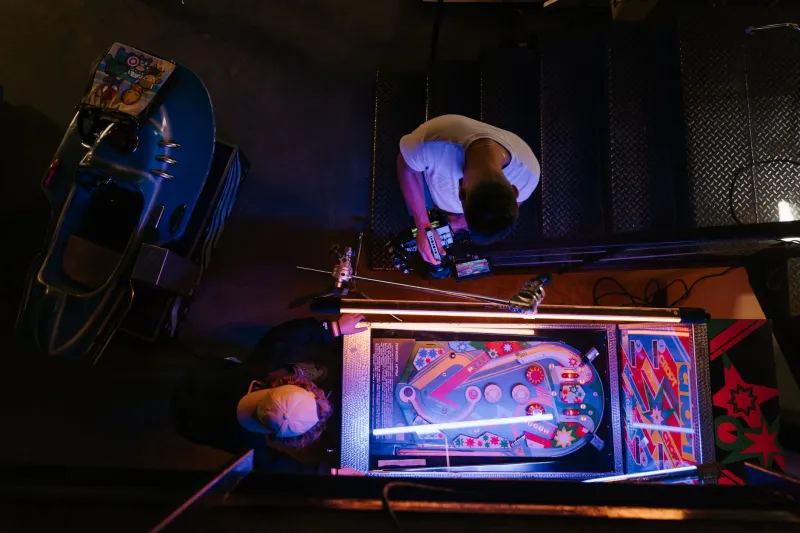
Let's be honest about something: these places photograph beautifully. Neon glow bouncing off cocktail cabinets, rows of marquee art glowing in the dark, someone silhouetted against a Galaga screen mid-game. The aesthetic content writes itself, and social media has absolutely turbocharged the discovery of these venues.
Owners have complicated feelings about this.
"The Instagram traffic is real and I won't pretend otherwise," says Marcus Holt, who runs Bit Lounge in Austin. "But the people who come just for the photo and leave—that's not our community. Our community is the people who come back. Who learn which cabinet has the sticky joystick. Who argue about the best Street Fighter II character for forty-five minutes."
The tension is between the venue as aesthetic experience and the venue as actual place. The most successful operators seem to have figured out that Instagram brings people in the door; the hardware keeps them coming back. A Mortal Kombat II cabinet doesn't stop being fun because it's been photographed a thousand times.
Competing With the Couch (And Winning)
Perhaps the most surprising thing about this whole phenomenon is that it's not just competing with other bars or restaurants—it's competing with home gaming setups that would have seemed science fiction in 1985. Modern gaming enthusiasts have 4K televisions, surround sound, gaming chairs, and libraries of hundreds of titles. And they're still leaving home to play Asteroids on a 43-year-old vector display.
The reason, owners and regulars agree, is something a home setup can't replicate: the shared physical space. The crowd noise when someone clears a difficult stage. The tap on the shoulder from a stranger who wants to go head-to-head. The collective groan when the high score gets broken.
"My gaming PC at home is objectively better than anything in here," admits Derek, a regular at a retro lounge in Chicago. "But my PC has never once made me feel like I'm part of something. This place does, every single time."
The arcade was never really about the games. It was about the room the games were in, and who was standing next to you. Turns out that's the part that didn't age.
The Quarter Isn't Just a Quarter
There's a ritual specificity to the arcade experience that resists modernization. The physical act of digging quarters out of your pocket. The weight of dropping one into a slot. The mechanical thunk of the credit registering. These are haptic memories encoded in millions of people who grew up in the 1980s and 90s, and they activate something that a touchscreen payment simply cannot.
Smart operators have leaned into this. Many still use actual quarters, resisting the move to tap-to-pay wristbands that some larger venues have adopted. The friction, counterintuitively, is part of the product.
Insert coin. Continue. The screen's been asking us that question for forty years, and we're finally answering it again—together.