Built Like a Brick: The Humble Game Boy's Quiet Revenge on the Age of Fragile Tech
Let's get one thing straight before we go any further: the original Nintendo Game Boy is not a nostalgia toy. It is a philosophical argument. Specifically, it is a 0.68-pound, AA-battery-powered, pea-soup-green-screened argument that the entire consumer electronics industry has been lying to you for the past two decades about what a portable gaming device is actually supposed to do.
And right now, in living rooms, at flea markets, and in the padded shipping envelopes of eBay sellers across America, that argument is winning.
Four AAs and a Dream
Here is a fun game to play at your next social gathering: ask someone what the battery life is on their Nintendo Switch Lite. Watch the pause. Watch them mentally calculate. Watch the slight frown. The answer, depending on what you're playing, hovers somewhere between two and a half and seven hours. Which, fine. That's okay. That's a portable gaming device doing portable gaming device things in the year 2024.
Now ask someone with an original Game Boy how long it runs on a fresh set of AAs.
About fifteen hours.
Fifteen. On batteries you can buy at a gas station checkout counter for four dollars. Batteries that, if the apocalypse hits, you can yank out of a TV remote or a smoke detector. The Game Boy does not care about your USB-C cable. The Game Boy does not care about your power bank. The Game Boy was designed for the world before you assumed there would always be an outlet nearby.
"That was very much intentional," says Marcus Webb, a hardware engineer and retro collector based in Portland, Oregon, who has spent the better part of a decade reverse-engineering vintage Nintendo hardware. "Gunpei Yokoi's whole design philosophy at Nintendo — what he called 'lateral thinking with withered technology' — was about using cheap, proven components in clever ways rather than chasing cutting-edge specs. The DMG-01 wasn't trying to be impressive. It was trying to be reliable." DMG-01, for the uninitiated, is the original Game Boy's internal project designation. It stands for Dot Matrix Game, first model. It is also, unofficially, a monument to engineering humility.
The Drop Test Nobody Asked For
There is a Game Boy on display at the Nintendo World Store in New York City that survived a mortar explosion during Operation Desert Storm in 1990. It still works. The screen is warped, the casing is scorched, and it looks like it lost a fight with a blast furnace, but pop in a copy of Tetris and it will run just fine. Nintendo kept it as a display piece because, frankly, what better advertisement could you possibly have?
Contrast that with the experience of, say, dropping a current-generation handheld face-down onto tile. The math on that is not great.
The Game Boy's casing — that thick, utilitarian gray ABS plastic — was overengineered in the most beautiful way. Nintendo built it for kids. American kids, specifically, who Nintendo's research suggested would absolutely destroy anything not constructed to near-military tolerances. The result was a device that could be dropped, sat on, left in a hot car, buried under a couch cushion for three years, and retrieved fully operational. Retro collector and repair technician Diane Holcomb, who runs a vintage game repair shop outside of Columbus, Ohio, estimates that about 85% of original Game Boys she receives "just need a screen clean and maybe a new capacitor or two. The bones are almost always fine. You can't say that about anything made in the last ten years."
The Library That Time Forgot to Kill
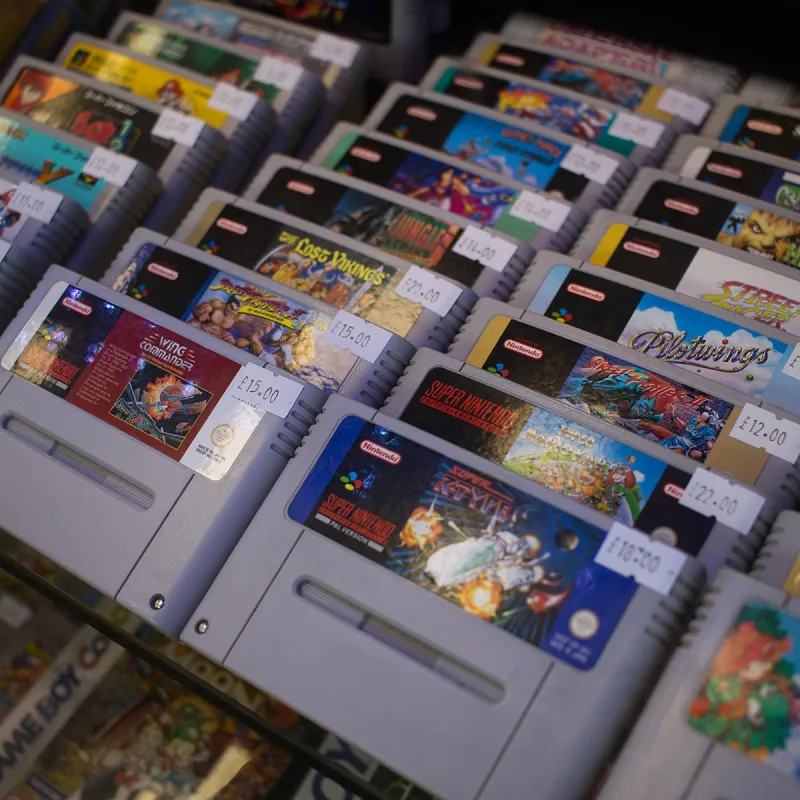
Durability is only part of the story, though. A very durable paperweight is still a paperweight. What keeps the Game Boy culturally and practically relevant in 2024 is its game library — a catalog of roughly 1,000 titles that, thanks to the system's surprisingly resilient cartridge format, remains almost entirely playable on original hardware without modification, emulation, or a subscription fee.
Think about what that means. No servers to go offline. No licensing agreements to expire. No digital storefront to shut down and vaporize your purchases. You own a gray plastic rectangle with a ROM chip inside it, and it will play exactly the same way in 2054 as it did in 1994, assuming you take care of the save battery (a ten-minute fix that costs about two dollars in parts).
"That's actually the thing I keep coming back to," says Webb. "We talk about Game Boy as nostalgia, but it's also just... a better ownership model? I own my copy of Link's Awakening in a way that I do not own my digital Switch games. That distinction feels more important now than it ever did."
And the games themselves hold up. Tetris, obviously — still the most elegantly designed puzzle game ever made, full stop. Pokémon Red and Blue, which launched an entire media franchise that generates more annual revenue than the GDP of several small nations. Kirby's Dream Land. Metroid II. The Legend of Zelda: Link's Awakening. A catalog that, unlike many retro libraries, was built around the constraints of the hardware rather than fighting against them.
What "They Don't Make Them Like They Used To" Actually Means
It's easy to dismiss "they don't make them like they used to" as boomer-coded grumbling. But in the specific case of the Game Boy, the phrase is load-bearing. It refers to a concrete, measurable set of engineering decisions: repairability, battery accessibility, physical durability, and software longevity. These are not accidental qualities. They were choices. Choices that the consumer electronics industry, somewhere around the mid-2000s, quietly decided were no longer priorities.
Modern portables are faster, sharper, more connected, and more capable in almost every technical dimension. They are also more fragile, more dependent on proprietary charging standards, more tethered to online infrastructure, and significantly harder to repair when something goes wrong. The Game Boy is slower and blurrier and plays games that look like animated graph paper. It is also, in a very real sense, freer.
That tension — between raw capability and genuine resilience — is why the Game Boy isn't just a collectible. It's a critique. And in a world where your phone needs a case, your earbuds need a case, and your case probably needs insurance, that critique lands a little differently than it used to.
Nintendo's chunky gray brick didn't outlast the competition by being the best. It outlasted them by being built to last. Somewhere in there is a lesson the industry has been studiously ignoring for thirty years.
Maybe it's time to start listening to the beeps.