Fake Carts, Real Feelings: Navigating the Murky World of Reproduction Game Cartridges
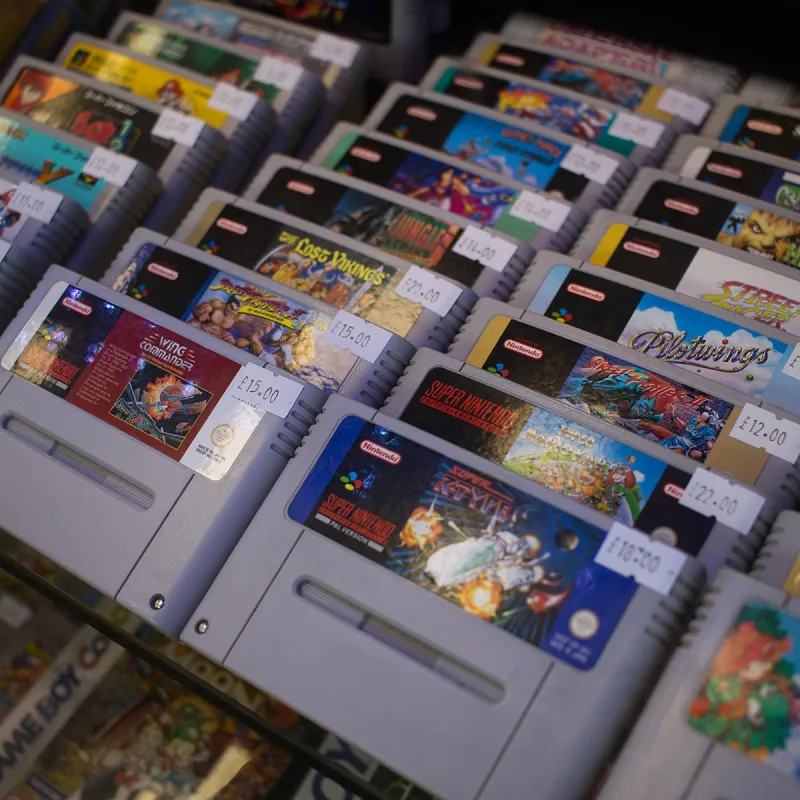
Photo: retro video game cartridges collection vintage Nintendo SNES close-up, via www.retro-sect.co.uk
Somewhere on eBay right now, a listing for a complete-in-box copy of Chrono Trigger for the Super Nintendo is sitting at $400 and climbing. The seller has twelve photos. The box looks perfect. The manual is crisp. The cartridge gleams under what appears to be very flattering lighting.
Is it real? Maybe. Maybe not. And that uncertainty — that low-grade anxiety humming beneath every vintage game purchase in 2024 — is exactly what has turned the reproduction cartridge market from a hobbyist curiosity into a full-blown underground economy with its own manufacturers, quality tiers, passionate defenders, and equally passionate detractors.
Welcome to the repro rabbit hole. Mind the gray area on your way down.
What Even Is a Repro Cart?
For the uninitiated: a reproduction cartridge, or "repro," is a physical cartridge that plays a game but wasn't produced by the original manufacturer. The spectrum is wide. On one end, you have lovingly crafted, clearly labeled fan-made repros of games that were never officially released in the US — Japanese exclusives, prototype builds, regional variants that never crossed the Pacific. On the other end, you have deliberately deceptive counterfeits designed to pass as originals and priced accordingly.
In between lives the bulk of the market: flash cartridges (like the EverDrive line) that can load entire ROM libraries from an SD card, and unlicensed reproduction boards running a single game's ROM, often sold openly on platforms like AliExpress and, with slightly more camouflage, on eBay and Facebook Marketplace.
The legal situation is, to put it charitably, complicated. ROM files of games you don't own are technically infringing on copyright. Manufacturing and selling cartridges containing those ROMs without a license is almost certainly infringement. And yet the market thrives, largely because enforcement is inconsistent and the original rights holders — many of whom don't actively sell the games in question — have little financial incentive to chase down every AliExpress storefront.
The Collector's Dilemma: Authenticity vs. Accessibility
Ask a hardcore collector about repros and you'll get a very specific kind of grimace. For them, authenticity isn't just preference — it's the entire point. A repro of Earthbound isn't a copy of Earthbound; it's a plastic shell with a chip inside that happens to run the same code. The cartridge itself — the specific board, the original battery, the label printed in 1995 — carries meaning that no reproduction can replicate.
"It's like the difference between a signed first-edition novel and a photocopy of it," says Terrence, a retro game collector from Nashville who has spent the better part of a decade building an authentic SNES library. "They contain the same words. They're not the same thing."
But then there's the other side of this argument, and it's hard to dismiss: authentic copies of many classic games have become absurdly expensive. A genuine copy of Panzer Dragoon Saga for the Sega Saturn — a game that Sega itself has acknowledged it can't even find the source code for — routinely sells for over $700. Little Samson on NES? Clear four figures. Stadium Events? We're talking mortgage territory.
For players who simply want to play the game, not archive it, the economics of authenticity are brutal. And that's where the repro market finds its most sympathetic customer.
The Flash Cart Question
Separate from repros but deeply intertwined with the same conversation are flash cartridges — devices like the EverDrive series from Krikzz, or the SD2SNES/FXPAK Pro — that allow you to load ROMs directly onto a real console from an SD card. These occupy a different moral position for many collectors: the hardware is legitimate, openly sold, and well-made. The question of what ROMs you load onto it is between you and your conscience.
Flash carts have become enormously popular among retro gaming enthusiasts who want the authentic hardware experience without the authentic hardware price tag. Playing a SNES game on a real SNES, through a real cartridge slot, on a real CRT television, but from a ROM file — is that authentic? It depends heavily on who you ask and how much they paid for their collection.
Jamie, a game preservationist from Chicago who asked us not to use her last name, argues that flash carts serve a legitimate archival function. "These games exist on aging media that degrades," she says. "Flash carts let people play them on original hardware without destroying the originals. I think that's actually good for preservation."
Spotting the Fakes (Before They Spot You)
For anyone navigating the secondhand market, the proliferation of repros has made buying vintage games a genuinely risky proposition. Counterfeit cartridges have become sophisticated enough to fool casual buyers regularly, and the tells that used to work — checking screw types, label printing quality, board markings — require increasingly specialized knowledge to apply correctly.
Communities like r/gamecollecting and various Discord servers have developed elaborate authentication guides, and YouTube channels dedicated to spotting fakes have racked up millions of views. There's even a cottage industry of cartridge testing services where, for a fee, experts will examine your purchase and certify its authenticity.
The irony isn't lost on anyone: a hobby built around playing games has spawned an entire meta-game of its own, with its own skill trees, knowledge checks, and high-stakes consequences.
Does Any of This Actually Matter?
Here's the question that makes collectors uncomfortable and casual gamers shrug: if the game plays identically, does it matter whether the cart is real?
For preservation, yes, absolutely — original media carries irreplaceable historical information about manufacturing, distribution, and the physical history of the medium. For investment, obviously — a repro is worth almost nothing compared to a genuine copy. But for the kid who just wants to play Super Metroid on a Sunday afternoon without taking out a small loan?
That's a harder case to make. And the repro market, whatever its legal and ethical complications, exists precisely because nobody has made it convincingly enough.
The authenticity debate isn't going away. If anything, as prices climb and original hardware ages, it's going to get louder. In the meantime, somewhere in a warehouse in Shenzhen, another batch of SNES-shaped cartridges is being loaded onto a shipping container. And somewhere in Ohio, a collector is squinting at a label under a UV light, hoping for the best.