Squares, Clicks, and Vibes: How Gen Z Fell Madly in Love With the Humble Floppy Disk
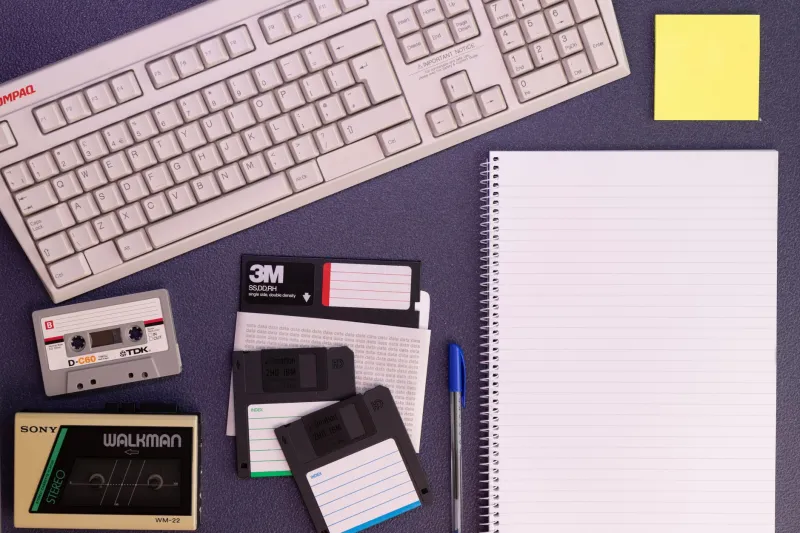
There's a particular sound a floppy disk makes when you slide it into a drive — that satisfying thunk-click of the shutter engaging, followed by a mechanical whirring that sounds like a tiny robot waking up from a nap. To anyone who grew up in the '80s or '90s, it's pure Proustian nostalgia. To a 19-year-old in 2025, apparently, it's aesthetic.
That's right. Gen Z — the generation that grew up with iCloud, Spotify, and enough digital storage to back up the entire Library of Congress on a device that fits in a jacket pocket — is buying floppy disks. On purpose. With their own money. Sometimes paying $15 to $20 a pop for the privilege.
Welcome to the floppy disk resurrection, and it is delightfully weird.
1.44 MB of Pure Intention
Let's be honest: a standard 3.5-inch high-density floppy disk holds 1.44 megabytes of data. That's less than a single decent-quality JPEG of your lunch. By every rational, practical measure, the floppy disk is a dead format — a relic that was officially phased out of mainstream computing somewhere around the mid-2000s, when even the nostalgia crowd had moved on to USB thumb drives.
And yet, eBay listings for bulk floppy disks are thriving. Etsy shops sell hand-labeled, artfully distressed floppies as decorative objects. Indie musicians are releasing albums — actual music — on floppy disk, pressed in limited runs of 50 or 100 copies, selling out within hours. There are Discord servers dedicated to floppy disk art. There are teenagers learning to use old IBM-compatible machines specifically so they can experience the ritual of saving a file to physical media.
This is not a drill. The floppy disk is back, baby, and it never even asked permission.
The Constraint Is the Point
Talk to anyone deep in the floppy revival scene and one word comes up over and over: constraint. When you're working with 1.44 MB, you can't overthink it. You can't layer 47 tracks of reverb-soaked synth. You can't upload a 4K video. You make choices — brutal, immediate, creative choices — because the format demands it.
Musicians using vintage samplers like the Akai S950 or the Ensoniq ASR-10 (both of which store samples on floppy disks, because of course they do) have been raving about this for years. These machines were workhorses of '90s hip-hop and electronic production, and a small but passionate community never stopped using them. Now a younger generation is picking them up at estate sales and gear swaps, discovering that the lo-fi, slightly gritty sample quality you get from a machine reading a floppy is something no plugin can fully replicate.
It's the same reason people shoot on film cameras or record to cassette tape. The limitations aren't bugs — they're features. When every tool you own is infinite and frictionless, sometimes you want something that pushes back.
A Very Loud "No" to the Cloud
There's also something quietly political happening here, if you squint. A lot of younger creators are genuinely uncomfortable with the idea that their work exists only as data on servers they don't own, governed by subscription models they can't opt out of and terms of service that change whenever a corporation feels like it.
Floppy disks — and physical media broadly — are a form of ownership that feels increasingly radical. You hold the disk. You label the disk. You stack the disk in a little plastic case next to your monitor like the world's least efficient filing system, and it is yours. Nobody can revoke your access. Adobe can't sunset it. The servers can't go down.
Is 1.44 MB a practical solution to digital impermanence? Absolutely not, don't be ridiculous. But as a symbolic gesture? As a way of saying "I made a thing and it lives in the physical world"? There's real emotional weight there, and Gen Z — a generation that has watched streaming services delete licensed content and seen social platforms nuke entire creative communities overnight — understands that weight intuitively.
The Collector's Corner (Population: Growing)
Beyond the musicians and artists, there's a thriving collector subculture treating floppies the way previous generations treated vinyl records or vintage baseball cards. Sealed boxes of old software — especially games, educational titles, and early desktop publishing programs — command serious prices. A pristine copy of an early Mac game or an unopened box of WordPerfect 5.1 for DOS can fetch anywhere from $30 to well over $100 depending on rarity and condition.
Part of this is pure nostalgia from older collectors. But a surprising chunk of buyers are younger enthusiasts who are drawn to the physicality of it — the box art, the hand-typed labels, the little cardboard inserts that came with shareware disks. In a world where most software is a download link and a license key, there's something almost magical about a program that exists as a tangible object you can hold.
Flea markets, thrift stores, and estate sales have become unlikely treasure hunts for this crowd. The holy grail? A box of old disks from a school computer lab or a small business that went under, where you might find anything from forgotten databases to someone's entire creative portfolio from 1993.
So Should You Be Worried About Your Old Stash?
If you've got a shoebox of old floppies in your basement — and statistically, a lot of you reading this absolutely do — you might be sitting on something more interesting than you realized. The data degradation is real (magnetic media doesn't last forever, and many disks from the '80s and early '90s are already failing), but the disks themselves, especially branded or interesting ones, have genuine collector appeal.
More importantly, if you've got an old drive still kicking around, maybe dust it off. Load something up. Listen to that thunk-click one more time.
Because here's the thing about the floppy disk revival: it's not really about the floppy disk. It's about reclaiming something intentional in a culture that has made everything instant, infinite, and weirdly disposable. It's about the satisfaction of a physical object and the creativity that comes from working inside limits.
Generation Z didn't invent that feeling. They just had the audacity to find it in a format the rest of us threw in a landfill fifteen years ago.
And honestly? We respect the hustle.
Got a floppy disk collection, a vintage sampler setup, or a deeply embarrassing story about losing a term paper to disk failure? Tell us about it in the comments — we have all day.